Friday, June 4, 2010

the flavor lingers


I arrived home to a MAJOR computer crisis, so you will all have to forgive me for taking so long to put pictures up from my adventure in Japan. This first post will not be textile related, but will give you a taste of delicious Kyoto at cherry blossom season. The day I arrived I was too wiped to take pictures except of the view from my window of the huge trees in the grounds of the Imperial Palace across the street.


The next morning was a sunny day and the palace was open to the public, something that happens rarely, so I braved the crowds and wandered over to view the cherry blossoms and take the tour. Sharing a picnic under the cherry trees is a favorite Kyoto tradition.


And crowds there were! Most folks were dressed casually. I saw a few kimonos and a lot of creative clothing combinations among the young girls in the crowd. Black leggings or tights and dainty net skirts seemed to be big.
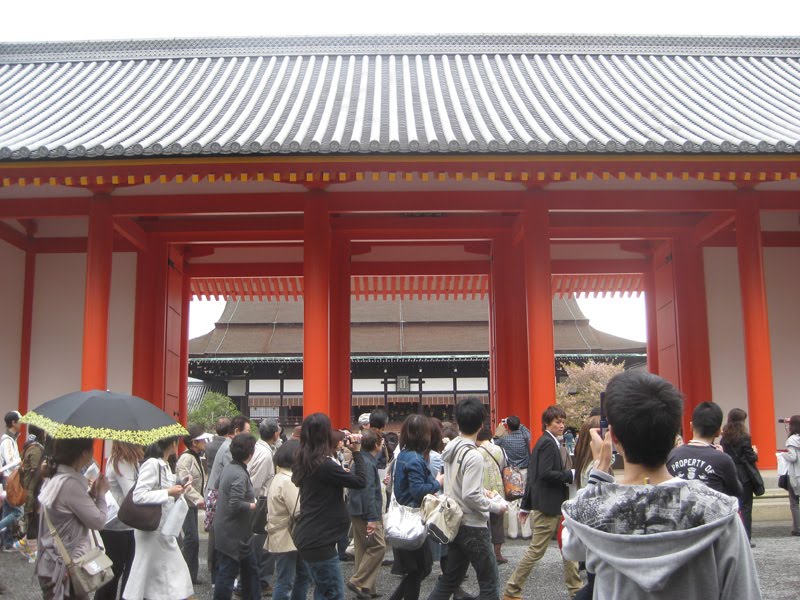


The gardens are extensive, mostly trees, but there were some more intimate corners as well.


In the afternoon I went downtown to catch an exhibit of contemporary katazome and recapture the flavor of the place. The exhibit just blew me away. It deserves a post of its own and I promise I will do one later.

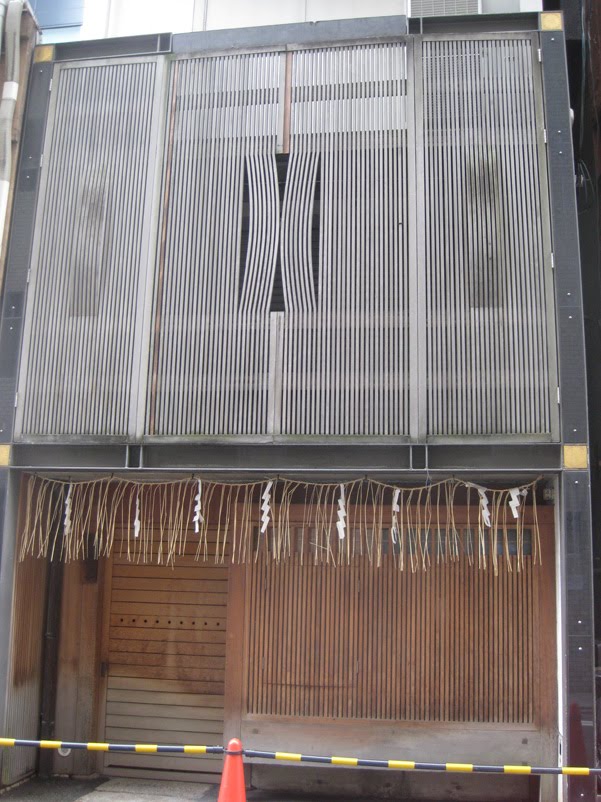
Kyoto itself, for those who have never been there, was undamaged in the war and lots of the old wooden houses with their latticed fronts still exist. Most people are familiar with them. I found this contemporary remodel interesting.

High fashion exists here as in any big city, and kimonos seem often to be rented for special occasions. This was the rental place down the street from the hotel.


Thursday, April 22, 2010

saving the best for last

This has been a busy week. Betsy Sterling Benjamin, who is the tour leader, worked in Kyoto as a batik artist for many years and has amazing contacts.

We began the first day with visits to the yuzen dyeing museum, the Nishijin weaving center and the well known indigo shop Aizen Kobo. These were all places I had visited the first time I was in Kyoto by myself and I will save descriptions for a later post when I can put up pictures.

The next two days we visited four totally amazing batik artists, in Japanese the term is rozome. The first one fed us what was supposed to be a light lunch but it was totally gorgeous. These visits will be better shown with puictures too.

The fourth day we went to a factory that weaves absolutely enormous theater curtains on the largest loom in the world, as well as tapestries and obis and the finest and most delicate weaving done with fingernails. Then we visited the Kyoto Seika University, an independent art school, and got to meet some students and faculty. The textile department would fill any American student of textiles with joy. Huge, well equipped and comprehensive. Wow.

We finished the day with a visit to a mountain hot spring resort, an onsen, for a soak in an outdoor heated pool with a relaxing view of the mountainside. We had dinner there and returned down the mountain by train.

We had a day off for sightseeing and visiting the temple market on Wednesday.

Yesterday we woke to pouring rain and caught the high speed train to Nagoya for a visit to Arimatsu, the world famous center for shibori. Ed and I had visited there as tourists but this trip was an entirely different animal. We were met by Mr. Takeda, the owner of the laargest shibori company and a descendent of the founder of the craft here four hundred years ago. We visited the shibori museum and then walked to see the factory of a contemporary shibori artist. He makes fabrics for Issey Miyake, curtains for Tiffany, and other marvels. We had lunch and then trecked along the Tokkaido to see the home and business of Mr. Takeda. This Edo era mansion is a wonder itself but he took us back to seek a display of modern kimonos and another of indigo dyed kimonos, some more than a hundred years old that I have seen pictured in books. He offered us tea in a tea house that 230 years ago was host to shoguns and daimyos. Shopping and the train trip home finished the day.

I can hardly wait to show you pictures.

Thursday, April 15, 2010

The avant garde

Saw a couple of modern exhibits today with two of the tour group who arrived early. Some lovely and interesting work and an installation of old bluejeans and jeans ads by Glen Kaufman, an American art bigwig, that did little for me. You rent the space for exhibits here so I guess you can put up whatever you want. He was an interesting man to meet actually, but the politics of contemporary art installations is often lost on me. Time to rest up for the tour tomorrow. I will keep you posted.

Wednesday, April 14, 2010

Life just gets better

The second day Mr Ohno invited an old friend, a retired art school professor and katazome expert, to stop by and use his better English to answer my more technical questions. That was actually a big help. I was especially curious about their resist paste (nori). They do not make it there but buy it from the nori shop, and then color it quite blue with aobana, a non reactive pigment. It is somewhat startling looking frankly, but it makes for hugely accurate paste application. Especially because, and this blew me away, they apply three layers of paste! The fabric is always attached to a long board or table so nothing can shift or distort and even the tiniest paste dots register perfectly. I have resisted this method, but for some things I can begin to see its usefulness. And the point is that the tiniest flaw is cause for the kimono seller to reject the entire bolt, so there is absolutely no room for error.

In the course of the discussion both men gave me much needed reasurance that my own artistic path is a valid one and that as long as I am making pieces that hang , where the hand of the cloth is not an issue, as it must be in their kimono tradition, pigment dyes are serving me well and there is no reason to switch over to synthetic dyes unless I want to.

Yesterday they took me to see the steaming and finishing operations and to visit another long board dyer. Then we went to peek into the nori factory. That was an eye opener. Kimono dyeing they tell me is failing in Kyoto, but based on the amount of paste ingredients and buckets of paste I saw there certainly did not look like any kind of decline. Evidently every dyer has paste made according to his specific recipes.

Home last night to another wonderful hot bath. Now I will be a tourist for a couple of days until the tour begins.

Back to the kobo at last

My hotel is on the west side of the Imperial Palace and this morning dawned cold but sunny enough to show me the sunrise for the first time since I arrived. I have had my directions upside down since I arrived for some funny reason so it was a relief to get my inner navigator straightened out. The cherry blossoms are still in evidence because the weather haas been cool although the peak is probably past.The steady downpour all day Monday did not help, but it did not dampen my spirits much. I was just having too much fun!

The workshop where I spent the last three days is called Kuryama Kobo (kobo means workshop). It is owned by a Mr. Ohno, who worked his way up to succeed the founder. He has a daughter who works in the kobo and his son-in-law, Mr. Nishida is the senior dyer. There is some evidence of little grandsons so the family succession in the business may be assured. The place is located up a narrow valley on the outskirts of Kyoto, along a stream, with overhanging cherry trees. A pretty place certainly, but a necessary location for a dyer because they rinse their fabric in water pumped from the stream. Originally the streams and rivers of Kyoto were terribly polluted from the dyeing industry and laws required them to relocate. The property includes houses for both couples.

I was given complete freedom to explore and photograph as long as I did not ask so many questions of the workers that they lost time from their work. I understand the process so a lot of questions were not necessary. It was the details that interested me most. They were working primarily on orders for summer obi. Interestingly, and it took awhile to figure this out, they were only painting the details on those portions of the obi that would show on the front and the knot at the back. This was a cost cutting measure for the purchaser, since most of the obi is hidden inside anyway.

The young staff was pleasant, helpful and interested in making my stay productive. I shared a bento lunch with them in their lunchroom. Good lunch too, and only 400 yen (about $4.25), a steal.

I have now edited this post. The lobby computers unexpectedly shift into Japanese or even more inscrutably duplicate whole phrases. It times out with about 30 seconds notice so I was lucky to finish my sentence!

Sunday, April 11, 2010

I visited the katazome exhibit I told you about yesterday and was left paralyzed with delight. The artist, a woman professor at a Kyoto art school artist, a woman professor at a Kyoto art school does katazome, but that is where the similarity ends. Her work is monumental in size, richly detailed and textural and lushly colored. Her inspiration for many years has been the sights and textures of Viet Nam. There was a video presentation that showed her technique and it was amazing. For those of you who know a little about katazome, it was a real departure from what I do. She uses synthetic stencil paper in very large sheets, without any silk mesh reinforcement, even when the lines were quite detailed. My suspision is that the strength of the synthetic paper makes that possible. She draws the detailed cartoon on the paper and edits as she cuts. The fabric is stretched tightly in a frame the size of the stencil and the paste she used seemed to be made mostly from the sticky rice flour, with less of the rice bran I use to keep the paste from sticking too hard to the fabric. The workshop where I am going tomorrow uses similar paste to cover painted portions of the design before painting the background. The dyes are acid dyes which must be steamed into the fabric and are much more penetrating than my pigments so probably the paste must be tougher. Anyway, this running on does nothing to explain the beauty of her work. You will just have to wait until I get home so I can show you pictures.

The rest of the day I did normal sightseing. I am amazed at the creativity of the Japanese, young and old, in combining wardrobe pieces . The results range from elegant to frankly odd but it is clear they are not just slopping through life without thinking about what they are wearing. We could probably stand to imitate that a little in the US. Actually the New Yorkers do a little better than the Corvallis-ites in that regard so maybe it is a big city thing, but the Japanese have such a history of paying attention to costume that they really take it to a new level.

Saturday, April 10, 2010

I am here! Safely installed in a hotel across from the grounds of the Imperial Palace. Since I start my dyers workshop experience tomorrow I have a lot to do and see today. Not the least being the cherry blossoms around town. I made a hasty trip yesterday the visit Tanaka, the store where I buy the fabric for my noren, and restocked. Thank goodness they will ship the eight bolts home seamail so I do not have to carry them home in my luggage. I did buy a gorgeous book on bingata, the process I will be studying while I am here. It was heavy, but I wanted to savor it in my room in the evenings so I kept it. I also bought some precut stencils, not something I normally indulge in. Curiously the newly cut synthetic stencils cost more than twice as much as the older traditional stencils which were much more finely cut. They are more fragile of course, but very lovely and I will enjoy using them. Kira Benjamin,who will conduct the tour at the end of the week tells me there is a gorgeous katazome exhibit going on so I will make a point of visiting there today. More later.....